
Public content served from the new content model and resolved through migrated aliases.
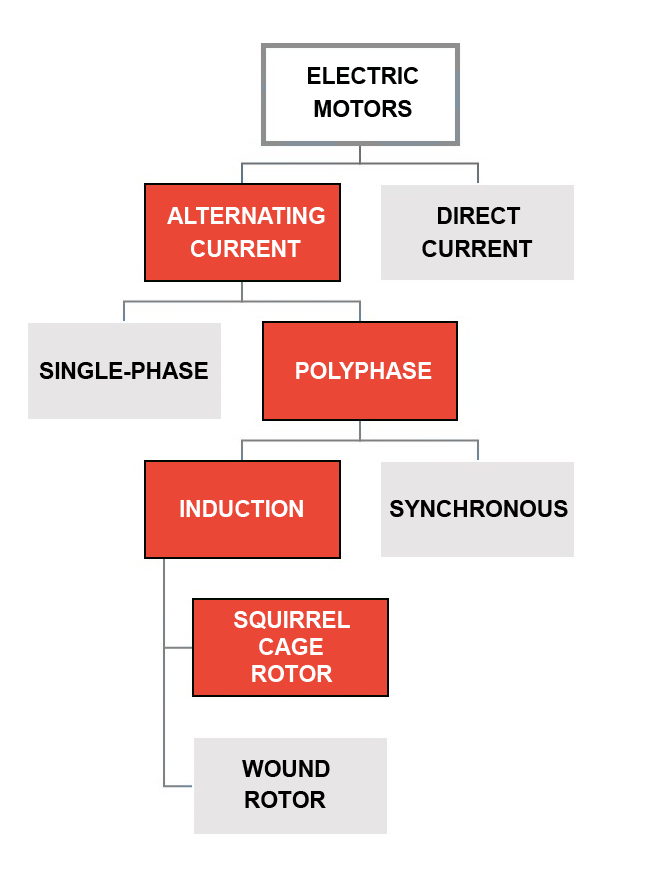
An electric motor is an electromechanical machine that converts electrical energy into mechanical energy. Electric motors fall into two broad groups: direct current (DC) motors and alternating current (AC) motors; alternating current motors are divided into single-phase and polyphase motors. Polyphase motors can be induction or synchronous. Then, induction motors can be wound rotor or squirrel cage rotor. The squirrel cage rotor motors are the most widely used engines in today's industry. Induction motors with squirrel cage rotors are relatively simple, very reliable, and low maintenance machines.
Induction motors operate under the principle of electromagnetic induction and are also known as asynchronous motors since their rotation speed (RPM) does not reach the synchronous frequency of the electromotive field. Induction motors are manufactured for various applications and requirements, operating speed, power, and efficiency, among other parameters, are considered for design, there are low, medium and high power motors, they are also manufactured to operate at various speeds; the amount of poles of an engine determines its operating speed.
| Number of poles | Synchronous Speed (RPM) depending on the Input Power Frequency | |
|---|---|---|
| 50 Hz | 60 Hz | |
| 2 | 3000 | 3600 |
| 4 | 1500 | 1800 |
| 6 | 1000 | 1200 |
| 8 | 750 | 900 |
| 10 | 600 | 720 |
| 12 | 500 | 600 |
| 16 | 375 | 450 |
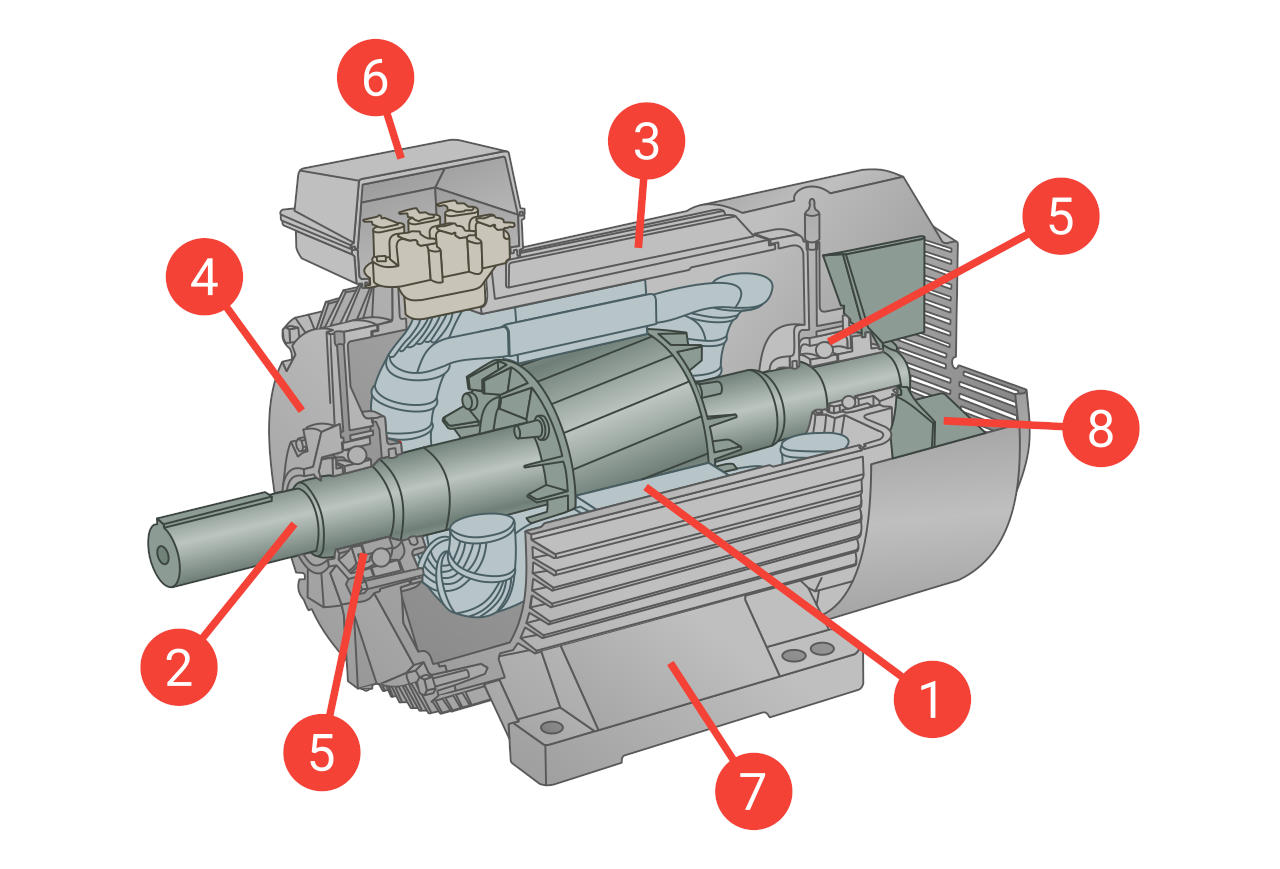
The main components of an electric induction motor with squirrel cage rotor are:
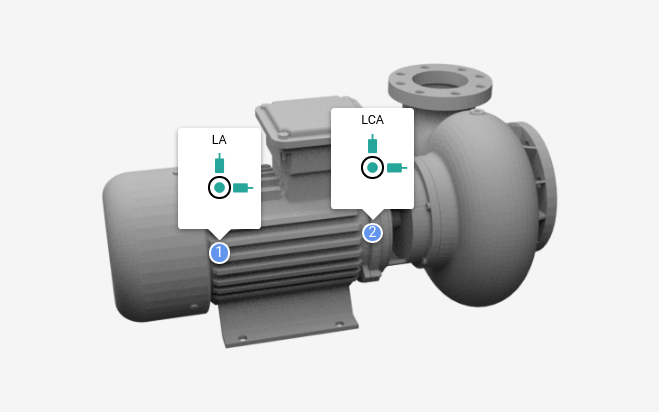
As we have already discussed in a general way in our article, "Where to place the vibration sensor", in an electrical motor, the measurement points for vibrations must correspond to the centerline of the shaft, on the bearing housing. Ensure a stable mounting on a solid part. Whenever possible, make measurements in the horizontal (H), vertical (V), and axial (A) directions of each bearing.
On the non-drive end position, it will not always be possible to place the sensor on the centerline, since the protective cover of the fan obstructs it, however, getting as close as possible to the bearing is recommended. Monitoring points should be marked, and data on the same locations are always taken. Some motor housings are made of aluminum; therefore, a magnet does not adhere; in these cases it can be held by hand by pressing firmly. Avoid the use of extensions as these suppress high frequency vibrations. In some applications, accessories are mounted for sampling vibrations; they are devices that are attached using glue or bolts, creating a fixed and firm to place an accelerometer.
Safety is the priority to select the vibration monitoring points; we must ensure that we do not make contact with rotating or hot parts, the safety in data collection takes care of the instruments and our health.
 Imbalance
In electric motors, an imbalance is usually caused by one of the following causes:
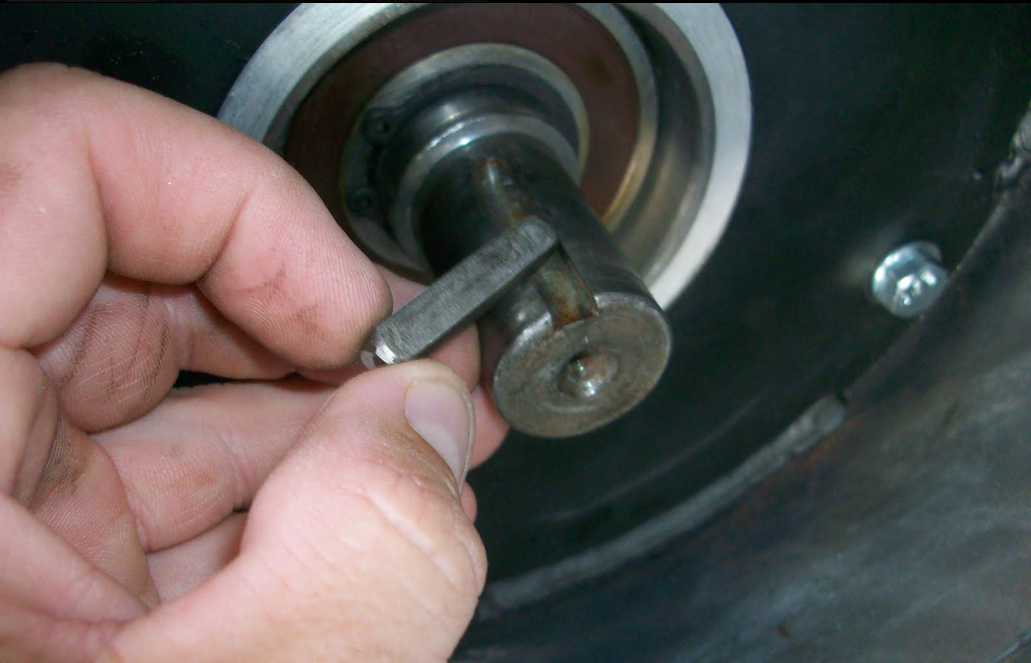
When an imbalance is diagnosed in an electric motor, the following actions may be recommended:
 Misalignment
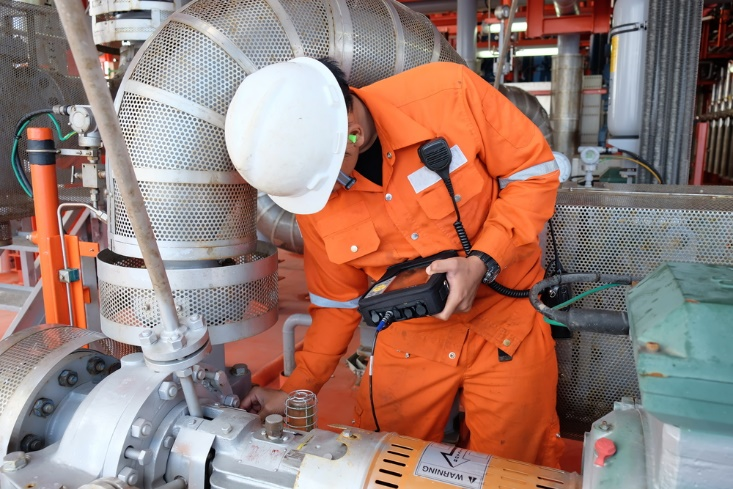
In electric motors, misalignment is usually caused by one of the following causes:
When misalignment is detected in an electric motor, could recommend the following:
 Bearing issues
In electric motors, bearing problems are usually caused by one of the following causes:
When bearing issues are detected in an electric motor, the following actions may be recommended:
 Eccentricity
In electric motors , eccentricity is usually caused by one of the following causes:
When eccentricity is detected in an electric motor, the following actions may be recommended:
 Rotating looseness
In electric motors, rotating looseness or clearances are usually caused by one of the following causes:
When gaps are detected in an electric motor, the following actions may be recommended:
 Structural issues
In electric motors, structural issues are usually caused by one of the following causes:
When structural issues are detected in an electric motor, the following actions could be recommended:
 Electrical issues
In electric motor, electrical issues tend to originate from any of the following causes:
When electrical problems are detected in an electric motor, the following actions may be recommended depending on the symptoms:
 Resonance
In electric motors, resonance is usually cause by any of the following causes:
When resonance is detected in an electric motor, the following actions may be recommended:
Inspection of electric motors must be comprehensive, including dynamic, thermal and operational tests. The following technologies also apply to electric motors:
| Predictive technology | Detectable failures | |
|---|---|---|
 |
Thermography, in the motor and in the power circuit | Lack of heat dissipation (cooling), overload, faulty connection, friction, load or voltage imbalance. |
 |
Visual inspections | Dirt, abnormal noise, safety flaws, structural issues, integrity of the grounding, bad cooling, humidity, leaks, loose bolts, loose connection, missing parts, deterioration. |
 |
Ultrasounds | Bearing issues, electric issues, lubrication issues. |
 |
Oil analysis or tribology | Bad lubricant condition, contaminated lubricant: water, glycol, fuel, solids; Inadequate amount of lubricant, quality and applicability of the lubricant, bad lubrication procedure. |
 |
Power quality analysis | Load imbalance, voltage, frequency, amperage, isolation condition, condition of the rotor bars, electric harmonics, efficiency. |

The permissible vibration limits for electric motors can be found in the ISO 10816-3 standard. The NEMA and IEC standards also establish some acceptance criteria.
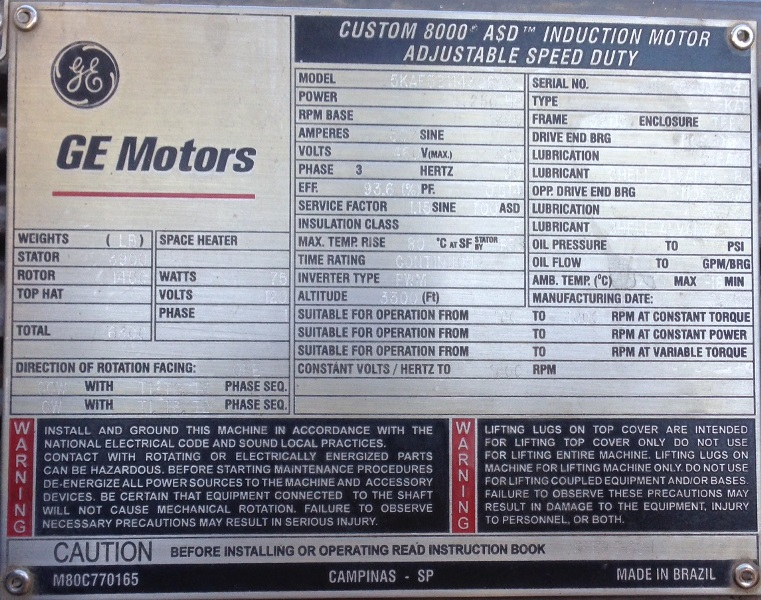
The identification plate is an essential source of useful information, and to understand it is a crucial factor; the plate data are parameters that should always be considered for reliable and efficient operation, effective inspection and proper maintenance. Operating a motor outside of its design limits will dramatically reduce its life and efficiency. Operators, inspectors, and maintainers must understand all these parameters and relate them to the operational and functional condition of the machine.
Locate the nameplate of the motors, protect it, and keep it in good condition. Solar radiation, environmental pollution and humidity affect the condition and readability of the plate.