

Public content served from the new content model and resolved through migrated aliases.
As a maintenance manager, you know that predictive maintenance (PdM) inspections are an essential part of maximizing the performance and efficiency of your equipment. But how do you determine the appropriate frequency for these inspections? One approach often used is setting frequencies based on the P-F time interval, also known as the failure-developing period.
But what exactly is the P-F interval? According to the article The P-F Curve and as shown in the image, it is the length of time it takes for a piece of equipment to fail once it shows signs of problems.
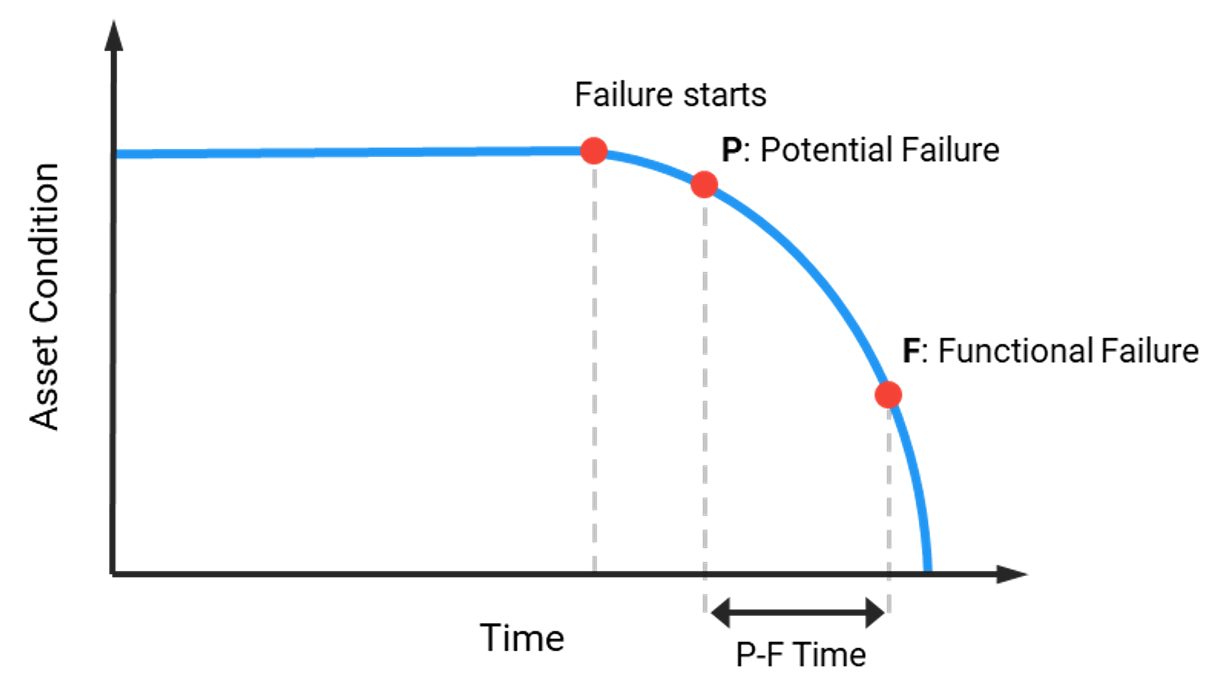
So, how do you use the P-F interval to set inspection frequencies for your PdM program? The general rule of thumb is to divide the P-F interval by two. This ensures that inspections are scheduled frequently enough to detect potential failures before they result in breakdowns, while also allowing time to plan and schedule corrective maintenance.
But what's the problem with using the P-F interval to set inspection frequencies for PdM? In my experience, I have found that it can be challenging to accurately determine the P-F interval for many assets. An average PdM program for one manufacturing plant can include 800-1200 assets, and I have rarely come across companies with complete fault records. Furthermore, I have yet to encounter a company that has calculated the P-F interval for even their most critical assets. This can make it difficult to set appropriate inspection frequencies based on the P-F interval.

So, is it really feasible to set frequencies for predictive maintenance inspections using the P-F time interval in the real world of maintenance?
It’s really not due to the following reasons:
In conclusion, it is not feasible to set frequencies for predictive maintenance inspections using the P-F interval in the real world of maintenance. While it may seem logical and straightforward in theory, the inherent variability and complexity of equipment make it difficult to accurately determine the P-F interval for many assets. So, don't be fooled by the simplicity of the P-F interval - it's not as straightforward as it may seem in the books!